Augusta's Best Bat Removal
We've been voted Augusta's best bat removal company the past two years!
Get in touch
Bat Experts
Rapid Response
Trained & Educated
Licensed & Certified
About Augusta Bat Removal
Welcome to augustabatremoval.com. We are the only qualified bat removal company in Augusta, Georgia. The health of your family is naturally one of the most important considerations in every choice you make, and with bats having a relatively high rate of rabies among their population this can be a significant concern for many people. However, the transmission of rabies from bats to people is extremely rare, but there are other conditions such as histoplasmosis which are much more commonly transmitted, and it can still be a very serious condition with significant health consequences. For this reason, having a professional animal removal company to deal with a bat infestation can really give you peace of mind that you and your family are safe during any bat removal work. All of our technicians have the right training and experience, and will also use protective equipment to make sure that they can do this safely. We also know that killing bats is not only illegal in many areas, but is hugely inefficient and increases the risk of disease transmission, which is why we will never trap or poison these creatures. Excluding bats is always more efficient, whether you are in a modern home with one or two points the bats are using to get in and out, or if your historic home has many more small cracks and holes to allow the bats in. We can also deal with any situation the bats leave behind, cleaning and disposing of bat guano and any soiled materials in the attic safely, and fully sealing the area so you can be confident the bats won't be coming back into your home. We operate 24-7-365, so don't hesitate to call us at 706-671-6166 to discuss your bat problem and schedule a fast appointment.
Residential
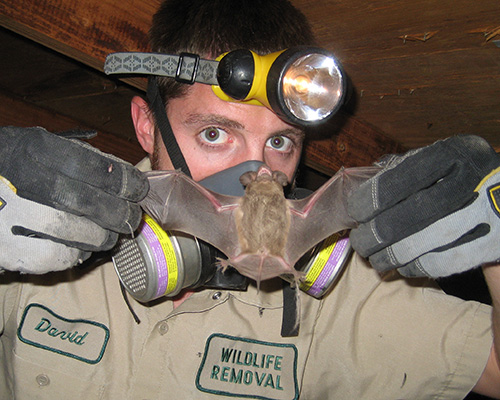
We are experts at removing bats from residential properties. Whether you have a single bat trapped in your house, a colony roosting in your attic, and/or various other problems, there is no need to worry! During our removal process, we make sure to inspect your entire home carefully, tracking down all the entrypoints bats are using to invade your place. Next, we perform a process called live exclusion (where no bats are harmed and all exit your property), then seal all entry holes completely shut. We also take care of the cleanup process after, so your home is safe and clean!
Learn MoreCommercial
Besides residential areas, we also have a wealth of experience removing bats from commercial properties! We begin by investigating the area for possible bat entrances, covering holes even as small as 1/4 of an inch. Through our live exclusion process, bats leave the building through one-way exits, and we seal up every hole afterward. Once the bats have been removed, we perform a cleanup process. This includes dealing with guano, replacing damaged insulation, and decontaminating the place.
Learn More
Contact us for bat removal today!
What Our Customers Say
I had a bat flying around in my house at 9pm, and CITY bat removal came right out and caught it in a net.
Sarah Lakewood
I had an annoying colony of bats stuck in my attic for a while before I finally decided to call for help. They were able to quickly and thoroughly solve the problem!
Brandon Chung
They did a great job clearing my attic of bats and didn't hurt any of the creatures.
Charlotte Demers
The technicians at CITY Bat Removal are skilled, professional, and know exactly what they're doing. Would highly recommend.
Mark O'Connor
My house stank of bats and their guano inside my wall. CITY Bat Removal not only removed the bats, they also got rid of the smell!
Alexis Ramirez
.jpg)
What are a bat's mating habits?
Around the world, there are over 1,300 species of bats, all of which are mammals that fly. That means that bats make up around 20 percent of all mammal species. Even though there are so many of them, bats only have one baby per year. Occasionally some have two and fewer still have up to four babies. Because of the huge variety of species, the way they mate will differ greatly.
When It Starts
Most bats begin the mating process in the fall when food is plentiful. Male bats are strong and healthy at this point. The act of mating occurs with the male taking hold of the female from behind. At that point, the female will either store the sperm until spring or keep the fertilized egg from developing until spring. Part of the reason they wait is because of their size. If they mated in spring rather than fall, the male bats will have been eating less from torpor, which is a fasting that occurs due to low food supply.
When Are They Born?
Because most bats eat insects and most insects do not come alive again until spring, pregnant bats usually wait until their food source is available. Those from a temperate region migrate to hibernacula, which is a winter hibernation site, where breeding can occur. Most bats that live in tropical regions do not migrate. They mate at a point when there is a seasonal variation in their food supply.
Actually Mating
Males and females meet for the first time in huge swarms at hibernacula. They begin by chasing each other and performing aerobatics. Because it is difficult to track and many of their mating habits occur at specific points of their process, it is unclear how bats choose their mates. Once chosen, though, most breeding pairs will go off to a secluded spot for privacy.
Examples of Variations Between Bat Species
Some of them, such as horseshoe bats, are far more discrete in their mating rituals. Females choose to visit males in their individual roosts. Bats that live in trees mate differently as well. For example, male hammer-headed bats are unique thanks to their larger-than-average nasal cavities and larynx. These guys will line up in trees along the riverbank while passing females fly by. They imitate the human concept of catcalling with a honking sound to woo potential mates. In comparison, sac-winged bats will fly then hover by potential mates while showing off their flying skills and wafting pheromones to increase their chances of mating.
Because of their versatility in how they behave, some of these flying mammals mate upside down. Others procreate on cave walls or in rock crevices. Most bats mate with multiple partners to ensure the species can continue with limited birth defects. Sometimes a large group of females, called a harem, will be defended by one or two males that they mate with.
Pregnancy Colonies
Most species create different colonies depending on whether they are pregnant. Pregnant females go to the same roost when giving birth and raising young. This can increase the heat which is needed for young bats to develop properly. There is also better protection because the number of bats can confuse predators. It is harder to pick out an individual bat from a large swarm of them. It only takes a couple of months for babies to grow to flying size and then, they can add to the distraction from predators. Around mid-summer, the babies are 95 percent the size of adults and are nearly indistinguishable.
Different Rituals
With most species, the mating ritual follows a common flow. With bats, a few of them are monogamous, meaning one male and one female mate. They create a family roost once children are born. For example, the spectral bat, which is the largest carnivorous bat in the world, is only one of the species where the male stays to protect and feed the young. This type of pairing is rarer in the bat world.
Many bat species separate males and females naturally, creating colonies of both. Bats are nocturnal, normally sleeping during the day while feeding and being active at night. During the mating season, the male will initialize contact by rubbing their heads against the female during the day. Generally, the actual copulation occurs at night during their more active routine.